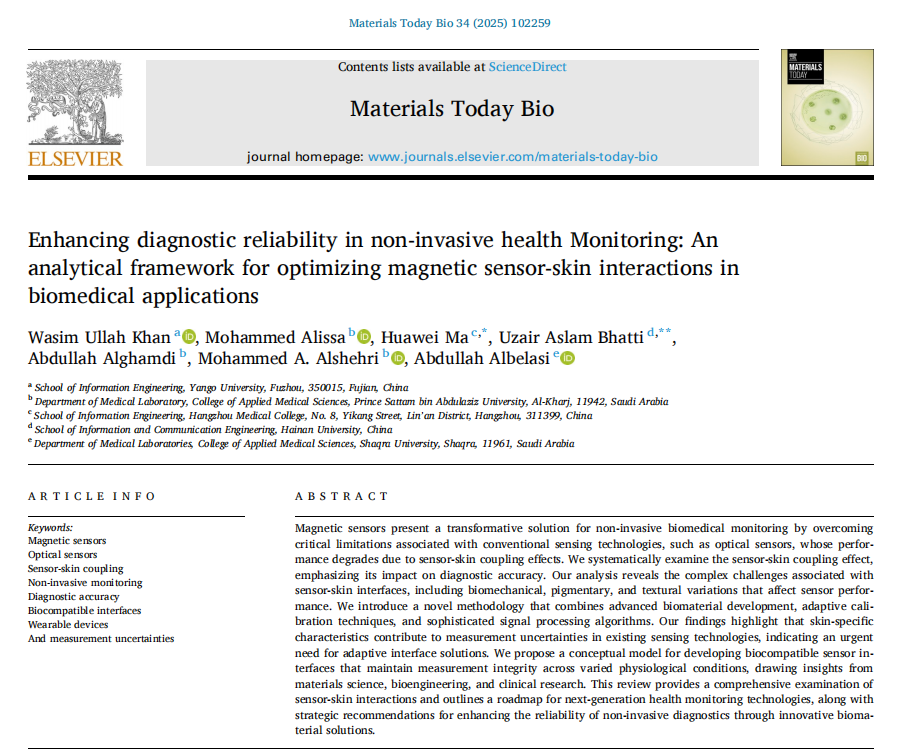
A research paper titled “Enhancing diagnostic reliability in non-invasive health monitoring: An analytical framework for optimizing magnetic sensor-skin interactions in biomedical applications”, authored by Dr. Wasim Ullah Khan from the School of Information Engineering at Yango University, has recently been accepted for publication in Materials Today Bio — a Chinese Academy of Sciences (CAS) Q1 journal with a 2024 Impact Factor of 10.2.
Dr. Wasim Ullah Khan earned his Ph.D. from the University of Science and Technology of China and currently serves as Associate Professor at Yango University’s School of Information Engineering. He previously conducted postdoctoral research at the School of Electrical Engineering and Automation, Wuhan University, and worked as an Associate Research Scientist at the Hong Kong Center for Cerebrovascular Health Engineering, affiliated with City University of Hong Kong. His research interests include biomedical signal processing, non-invasive health monitoring, intelligent wearable sensors, and computational intelligence.
This study addresses a critical challenge in non-invasive health monitoring: diagnostic reliability. It proposes an innovative framework integrating advanced biomaterials, adaptive calibration techniques, and intelligent signal processing algorithms to overcome performance limitations caused by skin coupling effects in conventional optical sensors. Machine learning algorithms are employed for adaptive sensor calibration, enabling model-based compensation for variations in skin properties. A deep learning-based ECG signal analysis system, combining Convolutional Neural Network (CNN) and Bidirectional Gated Recurrent Unit (BiGRU) architectures, is developed to achieve precise physiological signal interpretation. Additionally, the research optimizes the hardware design of magnetic sensors to enhance skin coupling stability. The findings provide essential theoretical and technical foundations for next-generation non-invasive health monitoring technologies.


 Current Position:
Home
>>
News & Events
>>
正文
Current Position:
Home
>>
News & Events
>>
正文


 Tiktok

 WeChat

 Micro-blog